
DOH CLINICAL COSTING & Clinicost Engine
Setting the Gold Standard in Abu Dhabi Clinical Costing
What is Abu Dhabi Clinical Costing?
Abu Dhabi Clinical Costing is a regulatory framework introduced by the Department of Health (DoH) in Abu Dhabi to measure, analyze, and report the actual cost of delivering healthcare services across hospitals and healthcare providers in the Emirate.
The system enables healthcare facilities to calculate the true cost of patient care by linking financial expenses, clinical activities, and patient encounters into a standardized costing model. This initiative supports Abu Dhabi’s transition toward data-driven healthcare funding, pricing transparency, and value-based healthcare systems.
According to the Abu Dhabi Clinical Costing Standard, clinical costing is defined as the process of measuring the cost and mix of resources used to deliver patient care, helping policymakers and healthcare organizations understand how healthcare resources are consumed during treatment.
Why Clinical Costing Was Introduced in Abu Dhabi?
Healthcare delivery involves complex operational structures and large financial investments. Without a standardized costing framework, healthcare providers may struggle to accurately measure service costs.
The Department of Health introduced Abu Dhabi Clinical Costing to address several key challenges in healthcare financial management.
Improving Healthcare Cost Transparency
Clinical costing provides a transparent method for calculating healthcare service costs, allowing regulators and providers to clearly understand how healthcare resources are used.
Supporting Value-Based Healthcare
Abu Dhabi’s healthcare system is transitioning toward value-based healthcare models, where quality outcomes and cost efficiency are critical factors. Clinical costing helps measure cost per treatment and supports better reimbursement structures.
Enabling Evidence-Based Policy Decisions
Reliable costing data helps policymakers analyze healthcare spending patterns and identify areas where healthcare delivery can be improved.
Standardizing Healthcare Costing Practices
Before the implementation of Abu Dhabi Clinical Costing, hospitals may have used different costing methodologies. The DoH framework ensures that all providers follow a consistent approach, enabling accurate benchmarking across facilities.
What is Clinicost engine?
The Clinicost Engine by Cyscode is an automated platform that transforms clinical and financial data into accurate, activity-based cost reports, enabling fast, error-free clinical costing and compliance with Abu Dhabi clinical costing standards. It streamlines data ingestion, cost allocation, validation, and reporting-helping healthcare providers achieve high accuracy, significant time savings, and full financial transparency.
How to Perform Abu Dhabi Clinical Costing Using Clinicost Engine
Performing Clinical Costing is now faster, simpler, and more accurate with the Clinicost Engine, an advanced clinical costing platform designed specifically to align with the Department of Health (DoH) Abu Dhabi Clinical Costing Guidelines (ADCCG) and the Abu Dhabi Clinical Costing Standards 2026.
Clinical costing has become a mandatory requirement for healthcare providers in Abu Dhabi, ensuring transparency, standardized cost allocation, and accurate financial reporting across hospitals and healthcare facilities. Under the DoH Clinical Costing Framework, providers must capture, allocate, and report the true cost of patient care services using structured methodologies and standardized data submissions.
Traditionally, performing clinical costing involved complex spreadsheets, fragmented data sources, and time-consuming manual calculations, making compliance challenging for healthcare organizations. The Clinicost Engine eliminates this complexity by providing a fully automated and intelligent clinical costing system that manages the entire process—from data ingestion and validation to cost allocation and DoH submission.
Built to support large-scale healthcare data processing, the platform integrates clinical, financial, operational, and utilization data into a unified framework. It applies standardized costing methodologies defined by Abu Dhabi Clinical Costing Guidelines, ensuring that healthcare providers generate accurate, auditable, and compliant costing outputs.
With Clinicost Engine, healthcare organizations can perform Abu Dhabi clinical costing with confidence, benefiting from:
- Intelligent cost allocation aligned with ADCCG methodology
- Built-in validation rules to ensure data accuracy
- Scalable processing capable of handling millions of healthcare records
- Ready-to-submit outputs compliant with DoH Abu Dhabi Clinical Costing Standards
By simplifying complex costing workflows, the Clinicost Engine empowers hospitals and healthcare groups to achieve full compliance with Abu Dhabi Clinical Costing regulations while improving financial transparency and operational insight.
Below is a step-by-step guide explaining how clinical costing can be easily performed using Clinicost Engine.
Step 1: Data Ingestion (Clinical Data Upload)
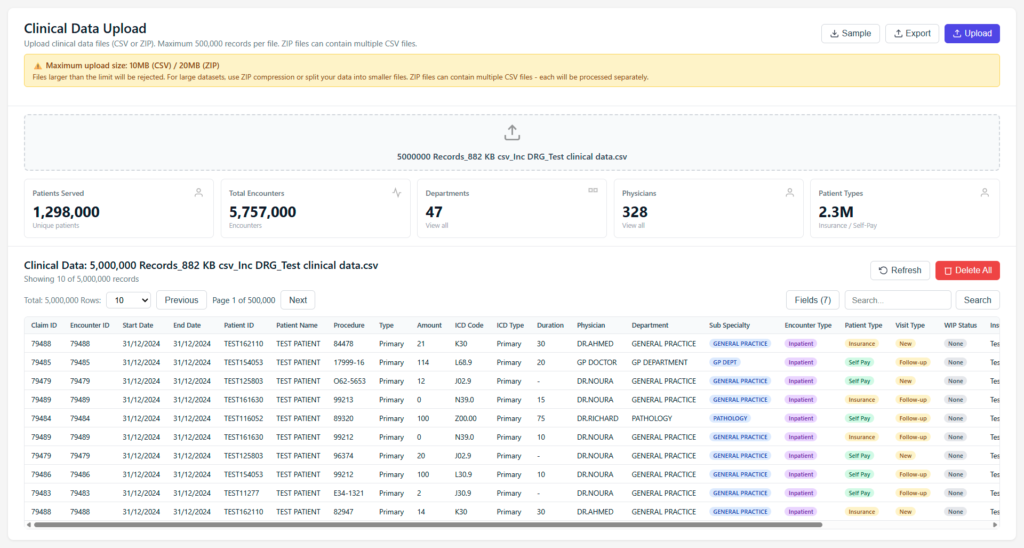
The first step in clinical costing is to upload your clinical data.
Extract data from your EMR system or claims database.
Download the Clinicost template and populate the required fields such as:
- Encounter details
- Procedure codes
- ICD codes
- Duration and department
Upload the completed file into the system.
Clinicost Engine supports processing millions of healthcare records in a single upload. The platform includes built-in validation checks during the upload process to ensure data quality, structural accuracy, and compliance with Department of Health (DoH) clinical costing requirements.
This step ensures your dataset is fully aligned with the Abu Dhabi Clinical Costing Standards 2026 and ready for the next stage of the clinical costing workflow.
Step 2: Expense Entry (Financial Data Upload)
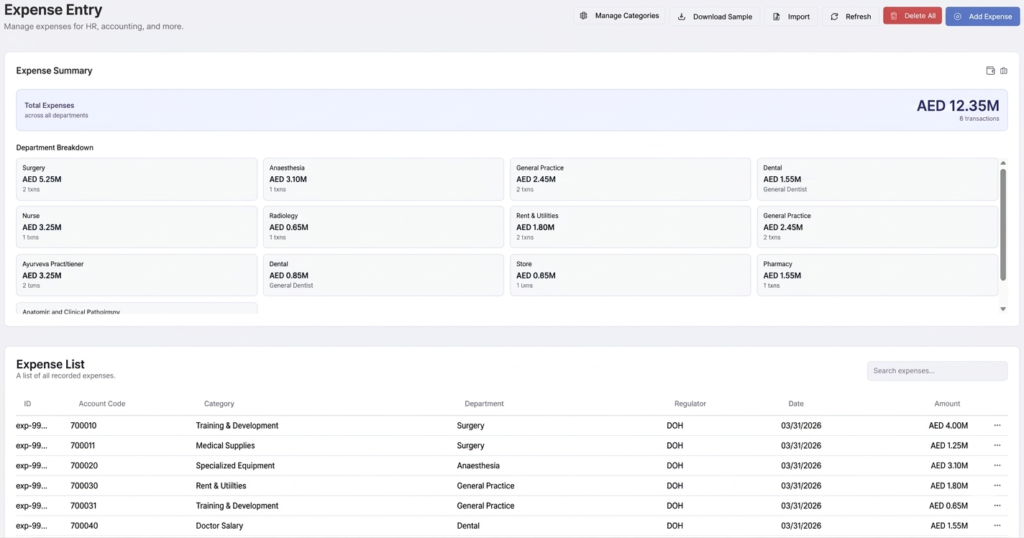
To comply with DoH Clinical Costing, financial data must be accurately captured.
Extract expense data from your finance ledger / GL.
Download and fill the standardized expense template, including:
- Cost categories (e.g., salaries, rent, consumables)
- Expense amounts and dates
Upload the completed file into Clinicost Engine.
This step ensures proper classification according to Abu Dhabi Clinical Costing Guidelines and forms the foundation for cost allocation and reconciliation.
Step 3: Design Costing Methodology
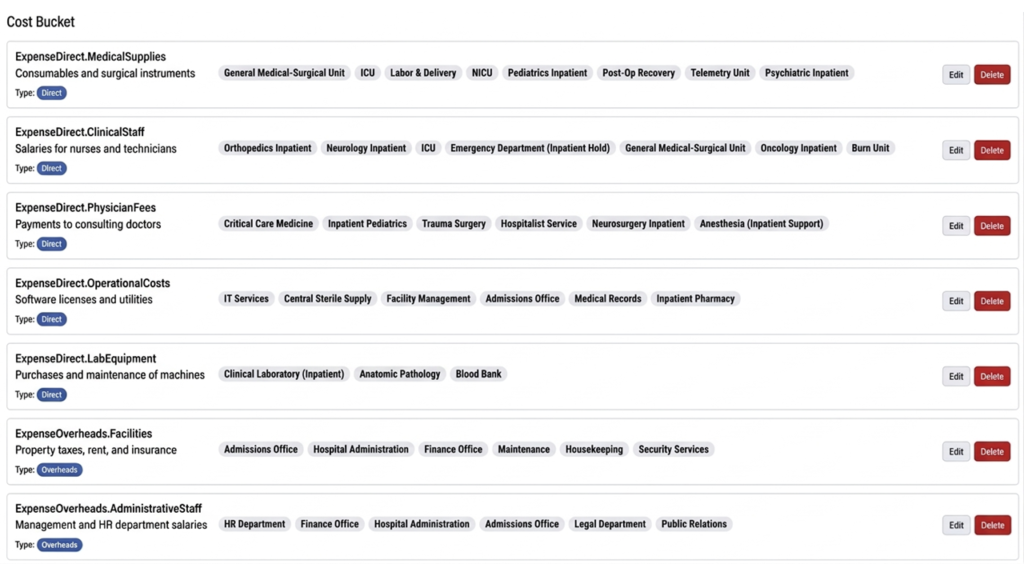
This is the core configuration stage, fully aligned with Abu Dhabi Clinical Costing Standards.
Key Activities:
- Create Products (procedures/services)
- Define Recipes (bill of resources for procedures)
-
Create Cost Buckets:
- Direct (Ward, ICU, Physician)
- Overheads (HR, IT, Finance)
- Map Cost Centers / Departments
- Configure Allocation Types & Drivers
Step 4: Run the Allocation Engine
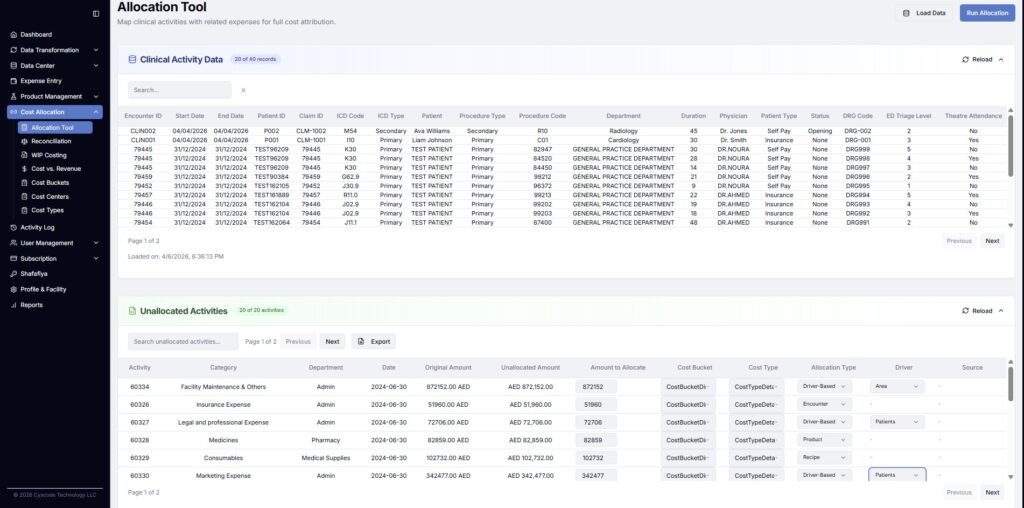
Once setup is complete:
Execute the allocation engine. The system distributes:
- Direct costs to procedures/patients
- Overhead costs using driver-based allocation
Features:
- Supports Step-down and Reciprocal allocation methods
- Automates complex costing logic as per DoH Clinical Costing requirements
Allocation Methods Include:
Direct Allocation:
- Encounter-based
- Product-based
- Recipe-based
- Time-based
Indirect Allocation:
- Area
- FTE
- Patient count
- Time
- Code
Fully aligned with DoH allocation logic and Abu Dhabi Clinical Costing Standards (ADCCS)
Step 5: Validation & Quality Checks
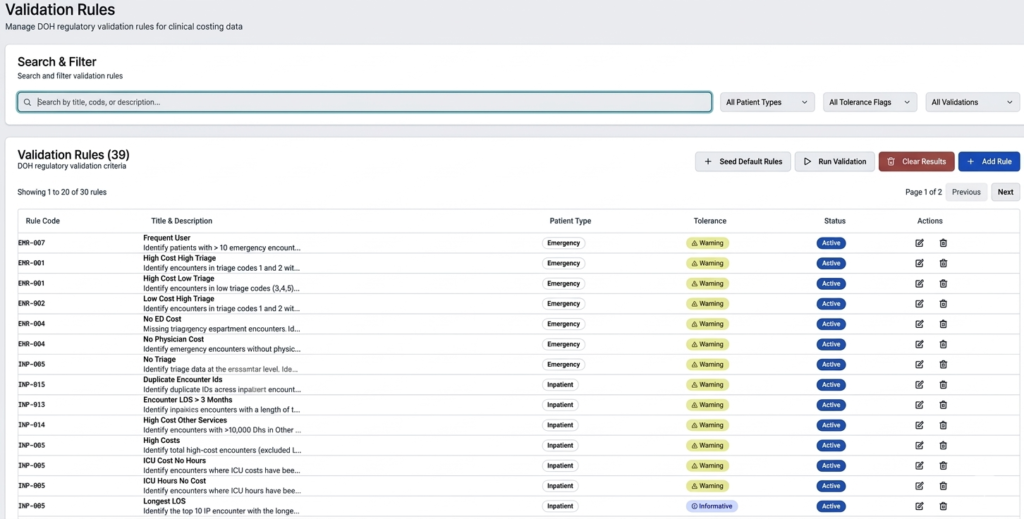
After allocation, validation is critical for compliance.
Clinicost Engine provides:
- 65+ built-in validation rules
- DOH-specific validation checks
Identify:
- Missing allocations
- Data inconsistencies
- Compliance gaps
- Ensures readiness for Abu Dhabi clinical costing submission
- Improves audit transparency and data accuracy
Note: Validation must be completed before XML generation to ensure DOH compliance and avoid submission rejections.
Step 6: XML Generation & Submission to Shafafiya
Once your clinical costing data has been validated, the next critical step is generating XML files and submitting them through the Shafafiya platform. The Clinicost Engine simplifies this entire workflow into a structured and efficient process.
Step-by-Step Process
Data Transformation & XML Generation
After validation, the system transforms your processed costing data into the required DOH-compliant XML format.
- Ensures adherence to DOH data structure standards
- Eliminates manual formatting errors
- Prepares data for seamless submission
Configure Batch Settings
To optimize submission performance, XML files can be generated in batches.
- Recommended batch size: 100 to 300 records
- Batch size may vary depending on Shafafiya payload limits
- Helps avoid submission failures due to large file sizes
Generate XML Files
Click on Generate XML to create structured files:
- System automatically compiles validated data
- Files are formatted as per DOH standards
- Ready for upload without additional modification
Enter Shafafiya Credentials
Provide your facility's Shafafiya login details:
- Secure authentication required
- Ensures submission is linked to your licensed entity
Upload XML Files
Upload the generated XML files through the platform:
- Select the appropriate file
- Ensure correct batch and submission type
Validate XML
Run system validation before submission:
- Detects structural or data errors
- Ensures compliance with DOH requirements
- Mandatory step before final submission
Submit XML
Once validation is successful:
- Proceed with final submission
- Data is transmitted to DOH via Shafafiya
Monitor Submission Status
Track the progress and outcome of your submission:
- Check for Accepted / Rejected / Pending status
- Review error logs if applicable
- Re-submit corrected batches if required
Best Practices
- Always start with PTE_TEST before moving to PRODUCTION
- Maintain optimal batch sizes to avoid system overload
- Regularly monitor submission status for quick issue resolution
- Ensure credentials and configurations are always up to date
Step 7: DOH Reconciliation Submission
Generate Reconciliation Report
Compare:
- Total expenses vs allocated costs
Submit
- Reconciliation Excel (DOH template)
- CFO attestation
- Submit to DOH via official email as required
- Mandatory for DOH clinical costing compliance
- Ensures financial transparency and audit readiness
Manual Costing: Where One Error Can Ruin Everything
Manual computations are tying up finance teams for months or forcing costly third-party solutions.

Spreadsheet Chaos
Multiple versions, formula errors, and version control nightmares.

Inaccurate Allocations
Crude cost distribution methods don't reflect actual resource use.

Compliance Risks
Difficulty meeting DoH Shafafiya reporting requirements.

Resource Intensive
Requires significant FTE time to maintain and validate.
How Clinical Costing Engine Works
From raw data to compliant reports in minutes — not weeks.

Data Ingestion
Upload Raw CSV/Excel Datasets.

Cost Allocation
Apply activity-based costing methodologies.

Validation
Automated checks ensure data accuracy.

Shafafiya Reporting
Generate XML and submit via platform
5 Key Benefits of Clinicost Engine for Abu Dhabi Clinical Costing
Comprehensive tools for accurate clinical costing and compliance
Product Management
- Define healthcare services as products
- Attach costs & resources with recipes
- Standardize service costing for consistency
Advanced Reports & Analytics
- Cost per patient, service, or specialty
- Profitability analysis & financial KPIs
- Interactive dashboards for management decisions
Shafafiya Submission (DoH Compliance)
- Direct submission of costing data to DoH via Shafafiya Post Office
- Automated XML generation in DoH-approved format
- Error validation, acknowledgment, and compliance tracking
- Save time, reduce manual errors, ensure peace of mind
Cost Allocation Engine
- Allocate overheads across departments & cost centers
- Track Work-in-Progress (WIP) for inpatient care
- Analyze Cost vs. Revenue for every service line
- Flexible allocation drivers
Data Entry & Transformation
- Import financial, HR, and clinical data seamlessly
- Automated data cleaning, validation, and mapping any type of data
Who Can Benefit?

Multi-specialty Hospitals

Clinics & Day Care Centers

Healthcare Networks

Finance, RCM & Compliance Teams
Manual vs. Clinical Costing Engine
Manual Proces
- Weeks of manual effort
- Spreadsheet errors
- Per-diem allocations
- Compliance risks
Clinical Costing Engine
- Automated processing
- Consistent, auditable logic
- Activity-based costing
- Shafafiya-ready reports
Impact
- 90% Time Saved
- 100% Accuracy
- True Cost Visibility
- DOH Compliance
Value Delivered

Time Savings
Reclaim 90%+ of costing time for strategic financial analysis.

Accurate Costing
Activity-based methods reveal true service costs.
Compliance
Automated Shafafiya reporting meets all DoH requirements.

Cost Optimization
Identify savings opportunities with detailed cost visibility.
Automate Costs. Eliminate Errors. Gain Control.
Experience automated cost reporting that eliminates mistakes, saves time, and guarantees complete confidence in your numbers.
Frequently Asked Questions
1. What are the DOH Clinical Costing Guidelines for 2026?
The Department of Health (DOH) Abu Dhabi has introduced the Abu Dhabi Clinical Costing Standard V2. These guidelines mandate that all healthcare providers-including hospitals and medical centers-calculate and report accurate, standardized cost data at the patient and encounter level. Our engine is specifically designed to align with these 2026 updates, ensuring your facility remains fully compliant.
2. How does the software handle Abu Dhabi Clinical Costing Standards?
Our Clinical Costing Engine automates the complex process of mapping your General Ledger (GL) to the required Standard Functional Delivery Areas (SFDAs). By using Activity-Based Costing (ABC) and step-down allocation methodologies, it ensures that both direct costs (like medical consumables) and indirect costs (like administrative overhead) are distributed exactly as required by the DOH standards.
3. Is the engine compatible with Shafafiya reporting?
Yes. A core feature of our platform is the automated generation of XML reports ready for the Shafafiya Post Office. It performs internal validation checks to catch “orphan records” or unmapped accounts before you submit, significantly reducing the risk of rejections or DOH audit queries.
4. Why is clinical costing now mandatory for Abu Dhabi healthcare facilities?
The DOH has mandated clinical costing to transition the UAE healthcare market toward Value-Based Healthcare (VBHC). This transparency allows the regulator to benchmark procedure-level costs, identify inefficiencies, and support evidence-based pricing. For your facility, it provides a granular view of costs that traditional accounting cannot offer.
5. How long does it take to implement the Clinical Costing Engine?
You can subscribe to the Clinical Costing Engine at any time by clicking the Clinical Costing Login button, completing the required information, and selecting your preferred plan or contact us via https://cyscode.com/contact/.The setup process is quick and can be completed immediately after subscription. We provide end-to-end support, from initial data mapping to the final successful submission of your costing files.